
Grammar review
Hindi grammar
| Tenses | Formation | Example |
| Simple present tense /Habitual tense |
Subject+नहीं+Verb stem+ता/ते/ती+हूँ/हो/है/हैं | She doesn’t read the book. वह किताब नहीं पढ़ती है। |
| Past habitual tense | Subject+नहीं+Verb stem+ता/ते/ती+था/थे/थी/थीं | She used to play football. वह फ़ुटबॉल खेलती थी। |
| Present continuous tense/progressive aspect | Subject+object+ verb stem+ रहा/रहे/रही +हूँ/हो/है/हैं | I am drinking tea./I have been drinking tea for 2 years. मैं चाय नहीं पी रही हूँ। मैं दो साल से चाय पी रही हूँ। |
| Past continuous tense/past progressive | Subject+object+ verb stem+ रहा/रहे/रही + था/थे/थी/थीं | I was making tea. मैं चाय बना रही थी। |
| Indicative past tense | Tran- Sub+ने+ object+verb+ या/ई/ये/यीं Intra- Sub+verb+या/ई/ये/यीं |
मैंने खाना खाया। I ate food.
मैं सोया I (M.) slept. |
| Past perfect tense | Tran- Sub+ने+ object+verb+ या/ई/ये/यीं+हूँ/हो/है/हैं Intra- Sub+verb+या/ई/ये/यीं+हूँ/हो/है/हैं |
मैंने खाना खाया है। I have eaten food.
मैं सोया हूँI (M.) have slept. |
| Past perfect tense | Tran- Sub+ने+ object+verb+ या/ई/ये/यीं+ था/थे/थी/थीं Intra- Sub+verb+या/ई/ये/यीं+ था/थे/थी/थीं |
मैंने खाना खाया था। I had eaten food.
मैं सोया था। हूँI (M.) had slept. |
| Future tense | Sub+object+verb stem+ऊँगा/ऊँगी/ऊँगे/ऊँगीं | मैं खाना खाऊँगी। I will eat food. |
| Future continuous tense | Sub+object+verb stem+ रहा/रहे/रही+ होगा/होगी/होंगी/होंगे | I (M.) will be eating food. मैं खाना खा रहा हूँगा। |
| Subjunctive | Sub+object+verb stem+ऊँ/ए/एँ | मैं कमरे में आऊँ? May I come in the room? |
| Contrary to the fact present tense | अगर+sub+object+verb stem+ ता/ते/ती+तो+sub+verb stem+ ता/ते/ती | अगर मैं भारत जाती तो मैं हिंदी समझती। If I had gone to India, I would have understood Hindi. |
| Contrary to the fact past tense | अगर+sub+ ने+ object+perfect tense तो+sub+verb stem+ ता/ते/ती | अगर मैं भारत गई होती तो मैं हिंदी समझती। If I had gone to India, I would have understood Hindi. |
| Contrary to fact continuous tense | अगर+sub+object+verb stem+ ता/ते/ती+तो+sub+verb stem+ ता/ते/ती | अगर मैं भारत जा रही होती तो मैं हिंदी समझती। If I had been going to India, I would have understood Hindi. |
| Absolutive (कर) | sub+object+verb stem+ कर+ object+ verb (agrees with number and gender) | I go home and eat food. (Having gone home I eat food.) मैं घर जाकर खाना खाता हूँ। |
| postposition | Simple preposition |
| in | में मैं घर में रहती हूँ। I live in home. |
| on/at | पर मेज़ पर किताब है। the book is on the table. |
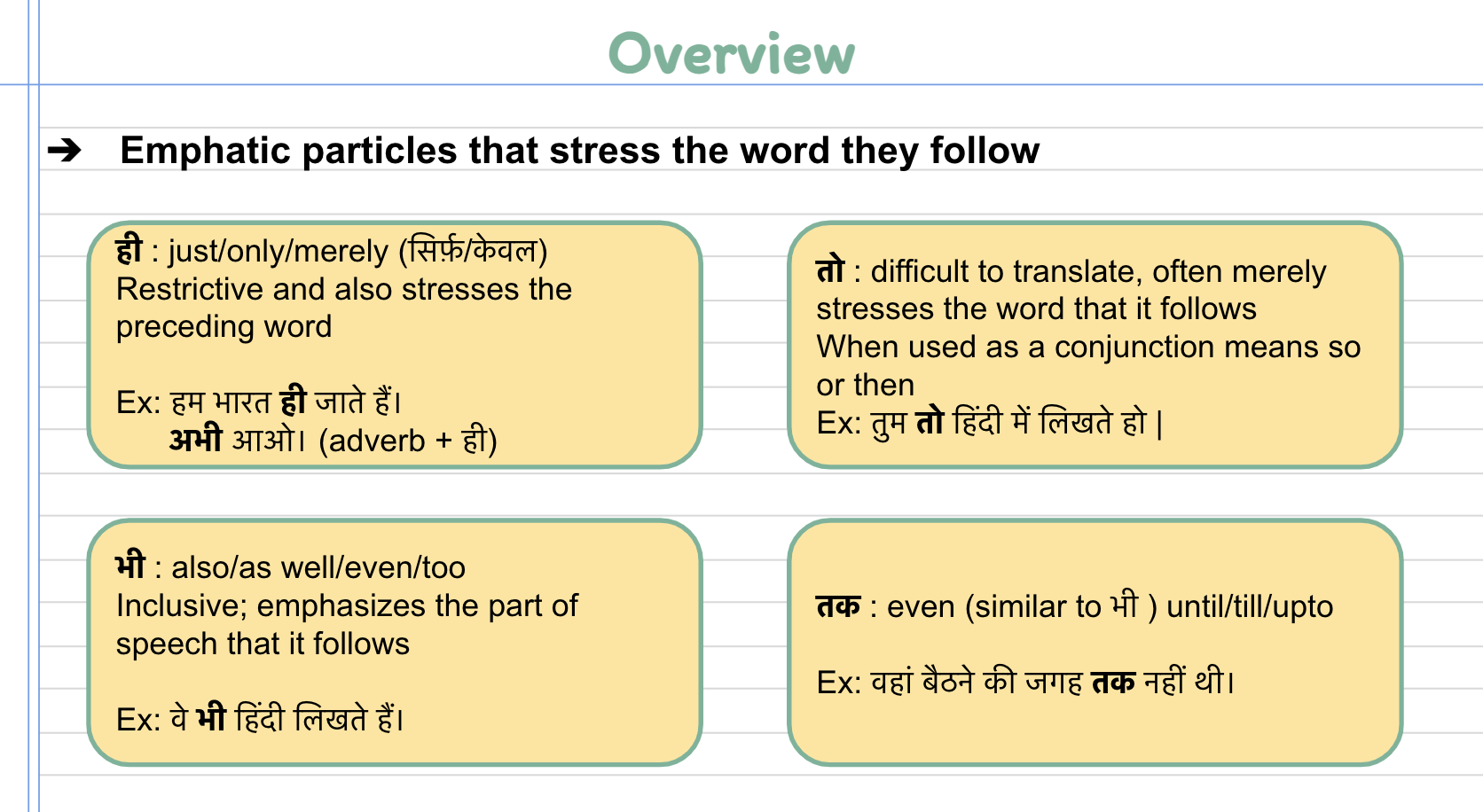
| until/up to | तक मैं शाम तक पढ़ता हूँ। I study till evening. |
| from/since | से आप कहाँ से हैं? Where are you from? |
| to | को आपको क्या पसंद है? What do you like? |
| postposition | Compound preposition | Example | |
| for | के लिए | यह फूल आपके लिए है। | This flower is for you. |
| in front of X | के सामने | मेरे घर के सामने कार है। | The car is in front of my home. |
| with | के साथ | मेरे साथ मेरी बिल्ली रहती है। | My cat lives with me. |
| below/under X | के नीचे | बिस्तर के नीचे बिल्ली है। | The cat is under the bed. |
| above/up X | के ऊपर | बिस्तर के ऊपर किताब है। | The book is above the bed. |
| to have/near X | के पास | मेरे घर के पास कॉलेज है। | My home is near the college. |
| Question | |
| What | क्या – आपका नाम क्या है? What is your name? क्या- क्या आप अमेरिकन हैं? Are you an American? |
| who | कौन- आप कौन हैं? Who are you? |
| whose | किसका- किसका नाम सोनू है? whose name is Sonu? |
| to whom | किसको- किसको आम पसंद हैं? who likes mango? |
| where | कहाँ- आप कहाँ से हैं? Where are you from? |
| when | कब – आप कब काम करते हैं? When do you work? |
| how | कैसा/कैसे/कैसी- आप कैसे हैं? How are you? |
| which | कौन-सा/सी/से – आपके पास कौनसा फ़ोन है? Which phone do you have? |
| how many/much | कितना/ने/नी – यह किताब कितने की है? How much is this book? |
| until when | कब तक – आप कब तक काम करते हैं? Until when/how long do you work? |
| for whom | किसके लिए – आप किसके लिए फूल लाए हैं? For whom do you bring flower? |
| about whom | किसके बारे में- आप किसके बारे में जानते हैं? Whom do you know? |


