
उतनी दूर मत ब्याहना बाबा! – निर्मला पुतुल
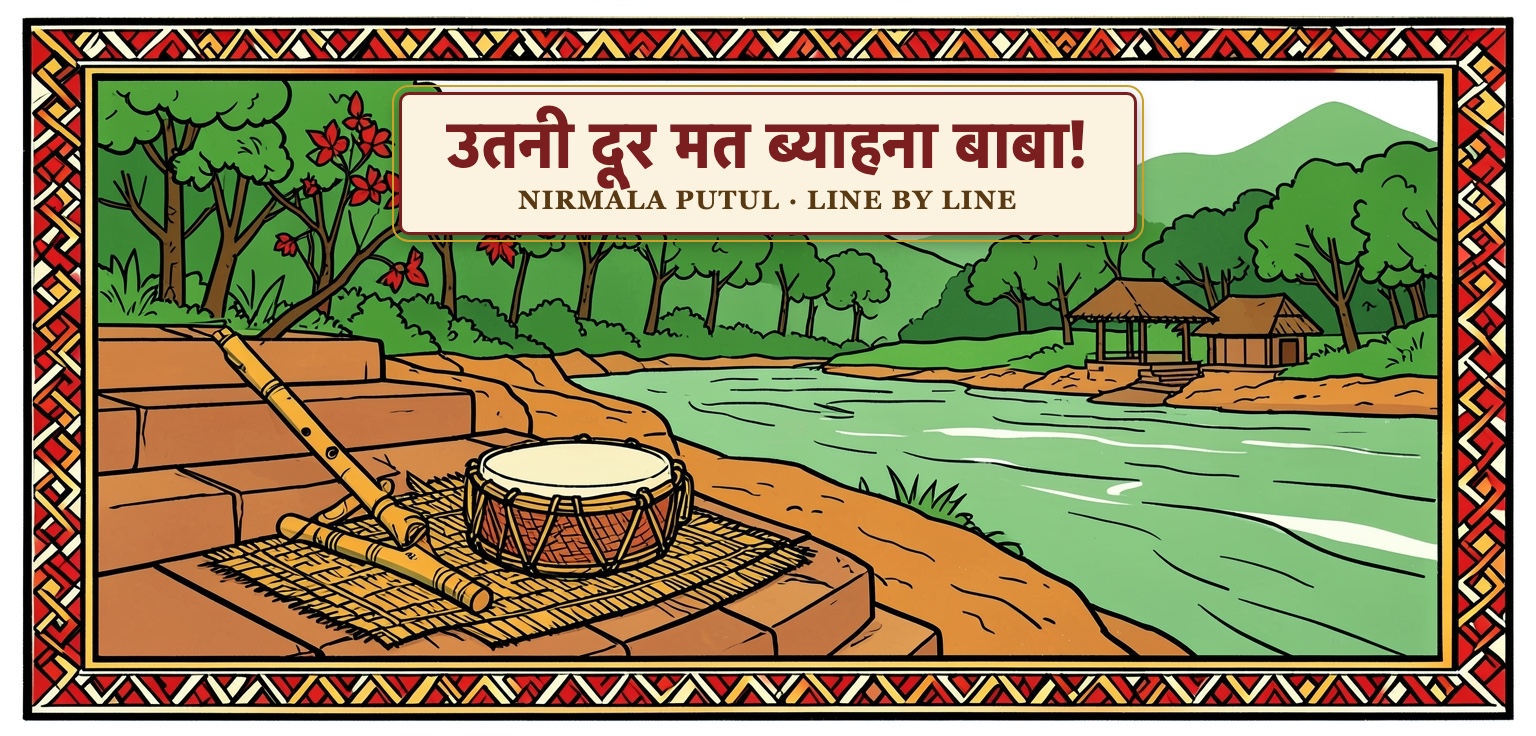
निर्मला पुतुल की इस कविता में एक बेटी अपने बाबा से कहती है कि उसकी शादी कहाँ और किससे करें।
In this poem by Nirmala Putul, a daughter tells her father where, and to whom, he should marry her.
उतनी दूर मत ब्याहना बाबा! · Don’t marry me off so far away, Baba!
Poet: निर्मला पुतुल (Nirmala Putul), a Santhal Adivasi poet from Jharkhand. From her collection नगाड़े की तरह बजते शब्द
कविता की पंक्तियाँ · Lines from the poem
The numbers are the line numbers in the full poem (75 lines)3.
| बाबा! | Baba (Father)! |
| मुझे उतनी दूर मत ब्याहना | Don’t marry me off so far away |
| जहाँ मुझसे मिलने जाने ख़ातिर | that, just to come and see me, |
| घर की बकरियाँ बेचनी पड़े तुम्हें | you would have to sell the household’s goats. |
| मत ब्याहना उस देश में | Don’t marry me into a land |
| जहाँ आदमी से ज़्यादा | where, more than people, |
| ईश्वर बसते हों | it is gods who live. |
| और तो और! | And what’s more! |
| जो हाथ लिखना नहीं जानता हो ‘ह’ से हाथ | a hand that cannot even write ‘ह’ for हाथ (hand), |
| उसके हाथ मत देना कभी मेरा हाथ! | never give my hand into that hand! |
| जिससे खाया नहीं जाए | The one who cannot bring himself to eat |
| मेरे भूखे रहने पर | while I go hungry, |
| उसी से ब्याहना मुझे! | marry me to him alone! |
पूरी कविता पढ़ें · Read the full poem
शब्दावली · Vocabulary
| बाबा | father (affectionate) |
| ब्याहना | to marry (a daughter) off |
| (की) ख़ातिर | for, for the sake of |
| बकरी (f.), बकरियाँ | goat, goats |
| देश (m.) | country, land |
| ईश्वर (m.) | God, a god |
| बसना | to live, to settle |
| वर (m.) | bridegroom |
| थारी-लोटा (m.) | plate and water-pot (household utensils) |
| घाट (m.) | steps down to a river, a landing |
| विलाप (m.) | lament, wailing |
| पलाश (m.) | flame-of-the-forest flower |
| जूड़ा (m.) | hair bun |
| भूखा रहना | to go hungry |
| और तो और | what’s more, on top of that |
व्याकरण · Grammar in the poem
जहाँ: “where…” clauses
जहाँ joins a description of a place to the noun it describes, often paired with वहाँ.
| मत ब्याहना उस देश में जहाँ… | Don’t marry me into the land where… |
| ब्याहना हो तो वहाँ ब्याहना जहाँ… | If you must marry me off, do it where… |
3. पड़ना: having to do something
तुम्हें बकरियाँ बेचनी पड़े: “you would have to sell the goats”. The person who must act takes को (तुम्हें = तुमको). The infinitive agrees with the object: बकरियाँ is feminine, so बेचना becomes बेचनी.
| मुझे किताब पढ़नी पड़ी। | I had to read the book. |
| उसे घर बदलना पड़ेगा। | He/she will have to change house. |
अभ्यास · Exercises
अभ्यास 1 · Advice for later (मत + -ना)
Rewrite each command as advice for later, using मत and the infinitive.
- रात को देर से घर आओ।
- घर की बकरियाँ बेचो।
- उसे यह बात बताओ।
- ठंडा पानी पियो।
- मेरी चिट्ठियाँ फेंको।
उत्तर देखें · Show answers
- रात को देर से घर मत आना।
- घर की बकरियाँ मत बेचना।
- उसे यह बात मत बताना।
- ठंडा पानी मत पीना।
- मेरी चिट्ठियाँ मत फेंकना।
अभ्यास 2 · Having to (पड़ना)
Make a sentence with पड़ना in the tense given. Make the infinitive agree with the object.
- हमें / बकरियाँ / बेचना (past)
- उसे / चिट्ठी / लिखना (future)
- पिताजी को / घर / बदलना (past)
- मुझे / दवाइयाँ / ख़रीदना (habitual present)
- तुम्हें / पैदल / जाना (future)
उत्तर देखें · Show answers
- हमें बकरियाँ बेचनी पड़ीं।
- उसे चिट्ठी लिखनी पड़ेगी।
- पिताजी को घर बदलना पड़ा।
- मुझे दवाइयाँ ख़रीदनी पड़ती हैं।
- तुम्हें पैदल जाना पड़ेगा।
अभ्यास 3 · Read and write
Answer in Hindi, then write your own short passage.
- बेटी बकरियाँ बेचने की बात क्यों करती है?
- ‘ह’ से हाथ वाली पंक्ति में बेटी कैसे आदमी की बात कर रही है?
- Write 4–5 sentences that begin like the poem: मैं ऐसी जगह रहना चाहूँगा / चाहूँगी जहाँ… Use जहाँ and से ज़्यादा at least once each.
स्रोत · Credits
- कविता · Poem: उतनी दूर मत ब्याहना बाबा! by निर्मला पुतुल (Nirmala Putul). All rights belong to the poet and the publisher.
- पुस्तक · Book: नगाड़े की तरह बजते शब्द, page 49. Publisher: भारतीय ज्ञानपीठ (Bharatiya Jnanpith), edition 2005.
- Text as published on हिन्दवी (Hindwi), Rekhta Foundation: hindwi.org/kavita/utni-door-mat-byahna-baba-nirmala-putul-kavita.
- Only short passages are quoted here, for teaching. The English translation, notes and exercises are by hindicentral.


